Cashew Supply Chain: From Farm Sourcing to Global B2B Markets
Cashew Supply Chain Overview
Understanding the Cashew Value Chain
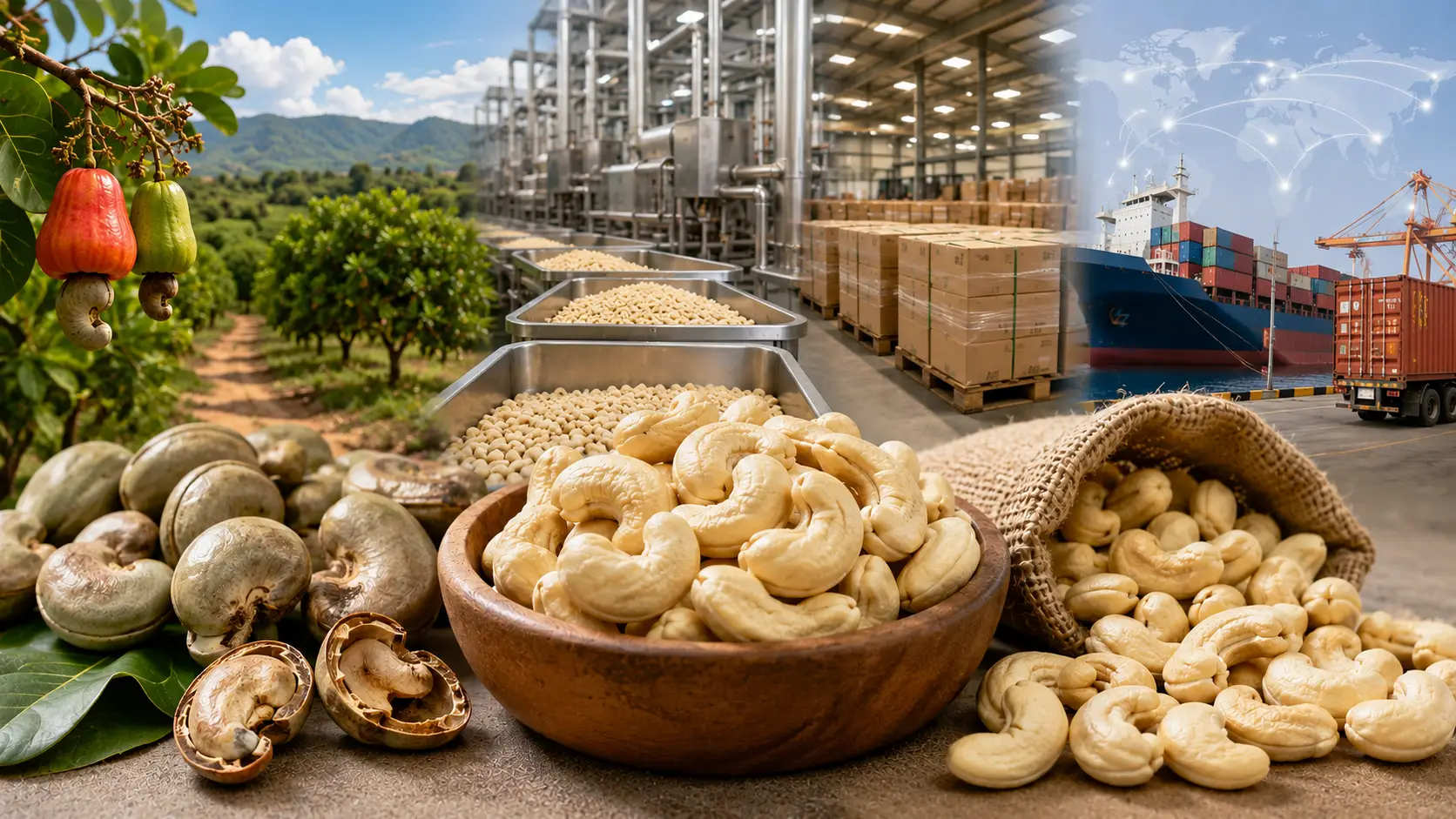
Cashew is a globally traded agricultural commodity whose commercial supply chain connects growers, collectors, processors, exporters, importers, distributors, food manufacturers, and retailers. Unlike a simple farm-to-market product, cashew moves through several value-adding stages before reaching industrial and consumer markets. FAO value-chain analysis identifies inputs, post-production handling, primary buyers, distribution, advanced processing, and final customers as interconnected parts of the cashew chain.
For B2B buyers, understanding these stages is important because sourcing decisions can influence product quality, availability, lead time, and procurement costs. Raw cashew nuts may enter the chain through farmers and cooperatives before being purchased by collectors, traders, or processors. The commercial structure can therefore vary considerably depending on the origin, level of local processing, infrastructure, and export channel.
Why Supply Chain Visibility Matters
Cashew sourcing is particularly dependent on coordination between agricultural production and post-harvest processing. Raw nuts are seasonal commodities, while processors and international buyers often require consistent availability throughout the year. Historical FAO research on India describes raw cashew as a seasonal commodity and highlights the role of village markets, traders, middlemen, processors, and wholesale purchasing in the supply chain.
A commercially effective supply chain therefore requires more than identifying a low-cost source. Procurement teams must consider origin, harvest timing, handling practices, processing capacity, quality specifications, documentation, transportation, and the reliability of trading partners. These factors determine whether a cashew supply arrangement can support repeat industrial purchasing rather than only individual transactions.
Cashew Production and Raw Material Sourcing
Farm-Level Cashew Production
Cashew originates from tropical growing regions and is now cultivated extensively across parts of Africa and Asia. FAO identifies numerous producing countries, including India, Tanzania, Mozambique, Brazil, Nigeria, Indonesia, Senegal, Malawi, and others. The crop can grow under a range of tropical conditions, although cold and frost are unsuitable for commercial production.
The production stage establishes the initial characteristics of the raw material entering the supply chain. Agricultural practices, tree age, local growing conditions, pest management, harvesting methods, and post-harvest handling can influence the consistency of raw nuts available to processors. For international procurement, origin therefore becomes an important consideration when evaluating potential supply partners.
Sourcing From Farmers and Collectors
Raw cashew nuts commonly move from farmers into local collection networks before reaching processing facilities. In many producing regions, collectors and traders aggregate relatively small farm-level quantities into commercially viable volumes. FAO's analysis of cashew value chains shows collectors, wholesalers, agents, brokers, transporters, processors, shippers, and importers as distinct participants that can operate between production and final markets.
The structure of these channels can affect both pricing and supply-chain efficiency. Research on India's raw cashew supply chain found that direct marketing between farmers and processors can create a shorter channel, while intermediary-based trading can create a longer route between producer and processor. For B2B buyers, establishing visibility over these sourcing layers can help identify opportunities to improve traceability and procurement efficiency.
Cashew Collection, Processing, and Value Addition
From Raw Nuts to Processed Cashew
Processing is one of the most commercially significant stages in the cashew supply chain because raw nuts must undergo several operations before the edible kernel becomes suitable for downstream markets. The value chain can include drying, shelling, washing, grading, roasting, packaging, and other processing activities depending on the intended product specification. FAO documentation on West African cashew identifies processing as a central component of the regional value chain.
The processing location can also influence international trade patterns. Producing countries may export raw nuts to established processing centers, while others increasingly invest in domestic processing to capture more value. This creates a procurement landscape in which buyers may source raw cashew nuts, processed kernels, or further processed products depending on their manufacturing requirements and supply-chain strategy.
Processing as a Value-Addition Stage
Processing transforms an agricultural commodity into standardized commercial ingredients and food products. Cashew kernels can be graded, roasted, salted, packaged, milled, or converted into products such as cashew butter and cashew milk. FAO value-chain documentation also identifies cashew apple processing and other forms of diversification as opportunities for additional value creation.
Cashew processing can also create commercially relevant by-products. FAO notes that cashew nut shell liquid, or CNSL, is a distinct material contained within the shell structure and has applications as an industrial raw material. This means an efficiently managed cashew supply chain can extend beyond edible kernels and create additional value streams from material that would otherwise remain underutilized.
Cashew Applications and Industrial Demand
Food and Ingredient Applications
The primary commercial role of cashew is as a high-value edible nut used across food markets. Cashew kernels can be sold as whole nuts, pieces, roasted products, salted products, and ingredients for processed foods. Their role in food manufacturing makes cashew relevant to snack producers, confectionery manufacturers, bakery businesses, ingredient processors, foodservice suppliers, and distributors.
For industrial buyers, the required cashew specification depends on the application. A processor manufacturing premium packaged nuts may prioritize kernel appearance and whole-kernel yield, while a manufacturer producing spreads, fillings, bakery ingredients, or processed foods may have different requirements. This creates multiple B2B demand segments within the broader cashew market.
Emerging Value-Added Applications
Cashew also supports diversification beyond conventional whole-kernel consumption. FAO documentation on Liberia identifies roasted cashews, cashew butter, and cashew milk as examples of value-added products that can broaden market opportunities for processors. Such diversification allows processors and ingredient businesses to use different grades and forms of cashew according to their production economics.
The wider cashew value chain can also incorporate the cashew apple and shell-derived materials. FAO identifies beverages, wines, preserves, and other products derived from the cashew apple, while CNSL has industrial applications including uses associated with coatings, plastics, waterproofing, and other material systems. For B2B traders, this creates opportunities to view cashew as a broader agricultural raw-material ecosystem rather than only a finished edible nut.
International Cashew Trade and Distribution
Global Movement of Cashew
International cashew trade connects producing regions with processing centers and consuming markets. Historically, India and Vietnam have played important roles in processing, while West African countries have become increasingly significant sources of raw cashew nuts. Research available through FAO's AGRIS database describes the expansion of production in Africa alongside the importance of Asian processing capacity.
Trade routes can therefore involve multiple geographic stages. A raw nut may be harvested in one country, collected and exported through another commercial channel, processed in a separate country, and subsequently shipped to an importer or food manufacturer. This multi-stage structure makes transportation, customs procedures, port capacity, inventory planning, and documentation important components of commercial cashew sourcing.
Distribution and Market Connectivity
After processing, cashew products may move through exporters, international traders, importers, distributors, institutional buyers, retailers, and direct commercial channels. FAO's cashew value-chain framework specifically identifies shippers, importers, distributors, institutional buyers, and retail as important downstream participants. This network allows cashew products to reach food manufacturers and final markets across different regions.
Recent developments also show growing attention to market organization and structured commodity trading. In Côte d'Ivoire, FAO reported in 2025 that stakeholders were preparing for the potential listing of cashew on a national agricultural stock exchange, with training focused on commodity exchange mechanisms and market-risk assessment. Such developments indicate the increasing importance of transparent market mechanisms for a strategically important agricultural commodity.
Cashew Buyers and Procurement Considerations
Identifying B2B Cashew Buyers
The buyer base for cashew extends across food manufacturers, processors, wholesalers, distributors, importers, snack companies, confectionery businesses, bakery manufacturers, foodservice suppliers, and retailers. Each buyer segment can require different grades, forms, volumes, packaging formats, and delivery schedules. Consequently, commercial suppliers benefit from understanding the technical and operational requirements of each purchasing segment.
Procurement teams generally evaluate more than the nominal product price when selecting a cashew supplier. Supply continuity, origin information, quality consistency, processing capability, documentation, packaging, shipment planning, and responsiveness can all influence the total commercial value of a supplier relationship. A competitive B2B sourcing strategy therefore evaluates the complete supply proposition rather than focusing exclusively on a single quotation.
Quality and Specification Management
Quality management is particularly important because cashew kernels can differ in size, color, moisture, grade, and other characteristics. Codex discussions have highlighted differences in national requirements and the importance of harmonized standards for cashew kernels in facilitating international trade. Buyers should therefore define product specifications clearly before purchasing, particularly when the material will be incorporated into standardized food manufacturing processes.
Supplier qualification should connect the buyer's intended application with measurable specifications. Depending on the product, procurement teams may assess kernel grade, appearance, moisture, foreign-material controls, packaging integrity, food-safety documentation, origin, and conformity with destination-market requirements. Clear specifications reduce ambiguity between supplier and buyer and make repeat purchasing more consistent.
Building a Reliable Cashew Supply Chain
Direct Sourcing and Supplier Relationships
A resilient cashew supply chain depends on relationships across the production and processing network. Direct sourcing arrangements between processors and farmer organizations can reduce unnecessary intermediary layers while improving communication about volumes, quality expectations, harvest timing, and purchasing requirements. Recent FAO analysis in Africa has specifically recommended developing secure supply chains through direct sourcing relationships between processors, farmers, and cooperatives.
For international buyers, direct sourcing does not necessarily mean eliminating every intermediary. Experienced exporters, traders, and distributors can provide valuable services involving aggregation, financing, quality control, logistics, documentation, and market access. The objective is instead to create sufficient transparency so that every important supply-chain participant contributes measurable value to the final procurement process.
Risk Management and Supply Continuity
Cashew procurement can be exposed to agricultural variability, seasonal availability, transportation constraints, processing capacity, market fluctuations, and changes in trade conditions. FAO's recent work in Guinea-Bissau emphasizes strengthening production practices, local processing, sustainability, and income diversification within the country's cashew value chain. These initiatives illustrate how supply-side improvements can influence the long-term reliability of commercial sourcing.
B2B buyers can respond by diversifying qualified suppliers, monitoring harvest and processing cycles, maintaining realistic lead times, verifying documentation before shipment, and developing contingency options for critical supply routes. A marketplace-oriented procurement model can also make it easier to compare suppliers and identify suitable sources according to origin, specification, volume, and commercial requirements. For global buyers, these practices help convert cashew sourcing from a transactional purchase into a structured supply-chain strategy.
Conclusion: Strategic Cashew Sourcing for B2B Markets
Cashew as a Global Supply-Chain Commodity
Cashew has a complex international supply chain that begins with tropical agricultural production and continues through collection, processing, grading, packaging, export, import, distribution, and food manufacturing. Its commercial importance is supported by diverse applications and a network of producers, processors, traders, distributors, and industrial buyers. Understanding this structure allows procurement teams to make better-informed decisions around sourcing and supplier qualification.
The supply chain is also evolving as producing countries seek greater local value addition, processors expand capabilities, and markets pursue more organized trading structures. Recent FAO initiatives in countries such as Guinea-Bissau and Côte d'Ivoire demonstrate continuing investment in productivity, processing, market access, and stronger commercial infrastructure. These developments can create new opportunities for international buyers seeking reliable and diversified sourcing channels.
Connecting Buyers With Reliable Sources
For procurement teams, the strongest cashew sourcing strategy combines product suitability with supply-chain visibility. Buyers should evaluate the origin of raw materials, processing capabilities, quality systems, logistics, documentation, and supplier reliability before establishing recurring purchasing arrangements. This approach can help manufacturers and distributors manage both operational requirements and changing market conditions.
Tradeasia / Chemtradeasia / Tradechem Marketplace can support B2B sourcing by connecting commercial buyers with relevant supply opportunities and helping businesses approach agricultural raw materials through a structured international-trade perspective. For companies purchasing cashew for food manufacturing, processing, distribution, or other commercial applications, the right sourcing partner can become an important part of building a more dependable and scalable supply chain.
Sources
https://www.fao.org
https://www.ers.usda.gov
https://www.fao.org
Leave a Comment