Introduction
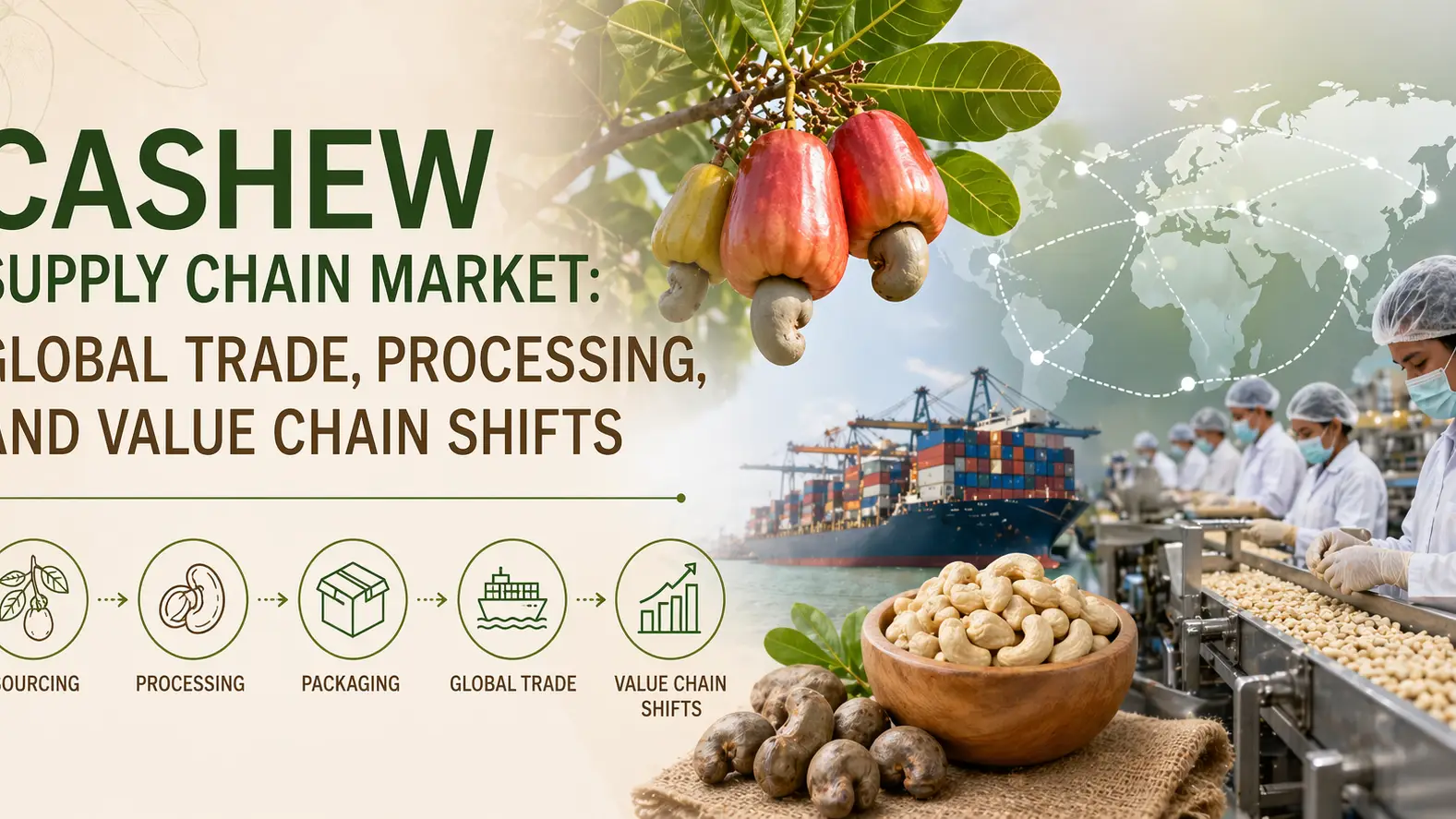
The global cashew supply chain market in 2026 stands at a critical intersection of agricultural dependency, industrial processing expansion, and geopolitical trade pressure. Demand for cashew kernels continues to rise steadily across food manufacturing, retail snacks, and plant-based applications, yet the underlying supply network remains highly fragmented across continents. West Africa dominates raw cashew nut production, while Asia—particularly Vietnam and India—controls large-scale processing and export distribution. This geographical imbalance continues to define cost structures, pricing volatility, and procurement risks for global buyers.
Recent market assessments indicate that the cashew industry is increasingly shifting from a volume-driven commodity trade toward a structured, value-added supply ecosystem, where traceability, consistency, and logistics resilience are becoming as important as price competitiveness.
Structural Shift in Global Cashew Production
One of the most defining dynamics of the 2026 cashew supply chain is the growing concentration of raw material production in West Africa, particularly Côte d’Ivoire, Ghana, and Nigeria. These regions collectively supply a majority of global raw cashew nuts, yet limited local processing capacity means that most of the harvest is exported for value addition elsewhere.
At the same time, Vietnam and India remain dominant processing hubs, with Vietnam alone handling more than half of global kernel exports. This structural dependency creates a dual-layer supply chain where raw material volatility directly impacts downstream manufacturing costs and global retail pricing. Even minor disruptions in African harvest cycles or export logistics can quickly ripple through Asian processing plants and international buyers.
Logistics Volatility and Trade Route Dependence
Global cashew logistics in 2026 are increasingly exposed to freight cost instability and maritime bottlenecks. The reliance on long-haul shipping routes between Africa and Asia means that any disruption—whether fuel price fluctuation, port congestion, or geopolitical tension—immediately affects landed cost structures.
Supply chain analysts highlight that cashew pricing spreads are already wide, with raw nut procurement costs significantly lower than processed kernel export values, but transportation and handling costs erode margins when logistics become unstable.
This has led global buyers, especially in Europe and North America, to prioritize supplier diversification and long-term contracts over spot purchasing. Procurement strategies are increasingly shaped by risk mitigation rather than pure price optimization, marking a structural shift in global sourcing behavior.
Processing Hubs and Value Addition Transformation
Processing hubs are redefining competitive advantage in the cashew supply chain. Vietnam continues to lead in mechanized shelling, optical grading, and export packaging technologies, allowing it to maintain efficiency even amid rising labor and energy costs. India, while still heavily reliant on traditional processing clusters, is gradually investing in modernization and automation to remain competitive.
A major 2026 trend is the “premium pivot,” where exporters are moving away from bulk kernel exports toward branded, certified, and value-added cashew products. This includes roasted, flavored, and retail-ready packaging formats aimed at higher-margin consumer segments.
This evolution is reshaping trade relationships, as buyers increasingly evaluate suppliers not only on price but also on processing capability, certification compliance, and consistency of output.
Climate and Agricultural Risk Reshaping Supply Security
Climate variability is emerging as a long-term structural risk to the cashew supply chain. Irregular rainfall patterns, drought stress, and temperature fluctuations directly influence flowering cycles and nut yields in tropical producing regions.
Even marginal changes in climate conditions can reduce kernel quality or delay harvest timing, creating uncertainty in global supply planning. As a result, procurement teams are increasingly integrating agricultural risk forecasting into sourcing decisions, while governments and agribusiness stakeholders invest in climate-resilient crop systems and improved plantation management.
These environmental pressures reinforce the need for diversified sourcing networks and more integrated supply chain intelligence across producing and processing countries.
Conclusion
The cashew supply chain market in 2026 is no longer defined solely by agricultural output but by the efficiency and resilience of its global value chain. Structural dependencies between Africa, Asia, and Western markets continue to shape pricing and availability, while logistics volatility and climate risk introduce new layers of uncertainty. At the same time, processing innovation and value-added transformation are creating opportunities for suppliers who can adapt to evolving buyer expectations.
In this shifting environment, global industrial buyers increasingly seek integrated sourcing partners capable of managing complexity across multiple geographies and product flows. Tradeasia International stands as a reliable global solution provider in this context, supporting industries with consistent supply chain coordination, diversified sourcing strategies, and long-term procurement stability across global commodity markets.
Sources
Leave a Comment