Introduction
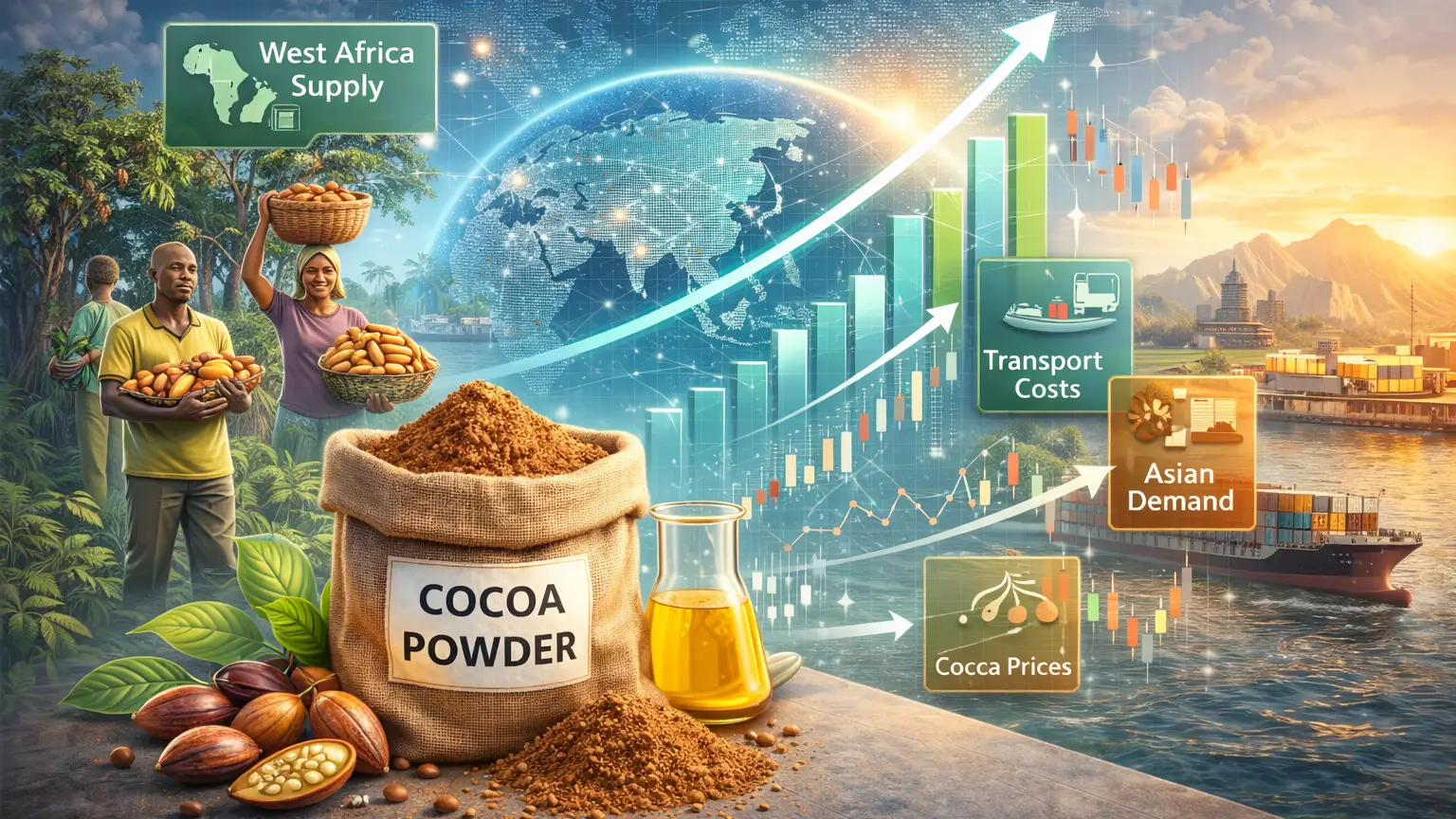
The global cocoa market is tightly interconnected, and few relationships are as influential as the one between West African cocoa harvests and cocoa powder prices in Asia. For American food manufacturers, beverage brands, bakeries, and ingredient traders, understanding this link is critical for cost management, product development, and long-term sourcing strategies. Because Asia has become a major processing and re-export hub for cocoa powder, any disruption in West Africa’s crop has a ripple effect that ultimately reaches the United States.
West Africa, led by Côte d’Ivoire and Ghana, consistently produces around 60–70% of the world’s cocoa beans. At the same time, Asian countries such as Indonesia, Malaysia, and increasingly China and Vietnam, have developed strong cocoa grinding and processing capacities. These Asian processors transform raw beans into intermediate and finished products, including natural and alkalized cocoa powder, which are then shipped worldwide, including to the American market.
This article explains how variations in West African harvests affect cocoa powder prices in Asia and what that means for American buyers. It also highlights how Chemtradeasia.com, a global B2B chemical and food ingredient trading platform, helps bridge these markets by offering diversified cocoa powder sourcing, transparent pricing, and logistics support tailored to American importers.
Global Cocoa Supply Chain: From West Africa to Asia
The modern cocoa supply chain starts on smallholder farms in West Africa, where millions of farmers cultivate cocoa trees on plots that are often less than five hectares. Côte d’Ivoire and Ghana alone account for over 60% of global cocoa bean production, with additional volumes coming from Nigeria, Cameroon, and emerging origins such as Sierra Leone. These beans are typically sold through national marketing systems or private traders, then exported to major grinding and processing hubs around the world.
Asia has become one of those critical hubs. Countries such as Indonesia and Malaysia have invested heavily in grinding capacity, enabling them to import beans from West Africa and convert them into cocoa liquor, cocoa butter, and cocoa powder. According to the International Cocoa Organization (ICCO), global grindings have grown steadily over the past decade, with Asia and Oceania’s share increasing as multinational and regional processors expand operations to serve both domestic and export markets. Asia’s role is no longer limited to local consumption; it is a strategic processing center that supplies finished cocoa ingredients to North America and Europe.
For American buyers, this means that cocoa powder sourced from Asia often originates from West African beans. The beans may be harvested in Côte d’Ivoire, shipped to an Asian port, processed in a modern grinding facility, and then exported as cocoa powder to the United States. Platforms like Chemtradeasia.com facilitate this multi-step journey by connecting reliable processors in Asia with customers in America, offering visibility into origin, quality, and logistics. As a result, any change in West African harvest volumes or quality directly influences the cost base of Asian processors and, ultimately, the price American importers pay for cocoa powder.
How West African Harvests Drive Asia Cocoa Powder Prices
West African cocoa harvests are highly sensitive to weather patterns, aging tree stock, disease pressure, and policy decisions. Events such as El Niño, irregular rainfall, or prolonged dry seasons can reduce yields, while diseases like black pod or swollen shoot disease can devastate plantations. In recent years, concerns over climate change, farmer income, and replanting rates have added further uncertainty. When harvest forecasts are revised downward, global futures markets on exchanges like ICE in New York and London typically react with higher prices for cocoa beans.
Asian cocoa processors purchase a large share of their beans based on these global benchmark prices. When bean prices increase due to a poor or delayed West African harvest, the cost of manufacturing cocoa powder rises. Processors must pay more for raw material, and they may also face tighter availability if exporting countries impose quality controls or adjust export policies. These higher input costs are then reflected in the contract prices offered to international buyers, including those in America sourcing through Chemtradeasia.com or directly from Asian manufacturers.
The price transmission from beans to powder is not always immediate, but it is consistent over time. Typically, processors hedge part of their bean purchases in advance, which can smooth short-term volatility. However, sustained supply constraints in West Africa—such as consecutive poor harvests or structural issues affecting farmer productivity—tend to push cocoa powder prices upward in Asia over the medium term. For American buyers, this manifests as higher quotations for both natural and alkalized cocoa powder, tighter contract terms, and increased importance of supplier diversification and forward planning.
Chemtradeasia.com: Linking Asia Cocoa Powder to American Buyers
Chemtradeasia.com operates as a global B2B platform that connects cocoa powder producers in Asia with industrial users and traders in markets such as the United States. By aggregating supply from multiple reputable manufacturers across Indonesia, Malaysia, India, and other Asian countries, the platform offers American buyers access to a broad range of cocoa powder grades, specifications, and price points. This multi-origin, multi-supplier model helps mitigate the impact of localized disruptions and provides buyers with options even when West African harvests are tight.
From a product perspective, Chemtradeasia.com supports a spectrum of cocoa powder types: natural cocoa powder with typical fat content around 10–12%, high-fat grades (up to 20–24% fat) for premium confectionery and chocolate applications, and alkalized (Dutch-processed) cocoa powder with varied pH levels for specific color and flavor requirements. The platform emphasizes consistent quality parameters such as moisture content (usually below 5%), microbiological standards suitable for food applications, particle size distribution, and compliant heavy metal limits based on importing country regulations.
For American companies, one of the key benefits of working through Chemtradeasia.com is improved transparency and risk management. The platform provides updated market insights, indicative price trends, and logistics options (FOB, CIF, or DAP to major U.S. ports). By monitoring West African crop reports, futures market movements, and freight conditions, Chemtradeasia helps buyers plan procurement strategies, such as locking in contracts ahead of expected price spikes or diversifying between origins and grades. This strategic support can be particularly valuable when West African harvest volatility threatens to disrupt supply and inflate costs.
Benefits and Applications of Cocoa Powder from Chemtradeasia.com
Cocoa powder sourced via Chemtradeasia.com is designed to meet the functional and sensory needs of a wide range of American food and beverage applications. Natural cocoa powder, with its lighter brown color and sharper cocoa note, is widely used in bakery mixes, cookies, brownies, and breakfast cereals. Alkalized cocoa powder, which has been treated to reduce acidity and enhance color, is favored in chocolate-flavored beverages, ice cream, compound coatings, and premium confectionery where a darker hue and smoother flavor profile are desired.
From a technical standpoint, cocoa powder specifications offered through Chemtradeasia.com typically include defined fat content (low-fat around 10–12% or high-fat up to 20–24%), pH range (about 5.0–6.0 for natural and 6.8–8.2 for alkalized), and bulk density suited to industrial handling and mixing systems. These parameters influence not only taste and color but also the behavior of cocoa powder in doughs, batters, and beverage systems—affecting viscosity, mouthfeel, and dispersion. Consistent quality is essential for large-scale American manufacturers who require repeatable performance in automated production lines.
Beyond traditional confectionery and bakery uses, cocoa powder distributed through Chemtradeasia.com is increasingly used in health-oriented and value-added products in the American market. Examples include protein shakes and nutrition bars with cocoa flavor, plant-based dairy alternatives, ready-to-drink cocoa beverages, and even functional foods enriched with cocoa’s natural polyphenols. The platform can support tailored sourcing for specific certifications—such as Halal or Kosher—and, where available, origins that align with corporate sustainability and ethical sourcing commitments. By leveraging Chemtradeasia’s network, American buyers can balance cost competitiveness, quality, and market positioning even as underlying bean prices fluctuate due to West African harvest conditions.
Conclusion
The connection between West African cocoa harvests and Asia cocoa powder prices is a defining feature of today’s cocoa supply chain. Weather variability, disease, and structural challenges in major producing countries translate into shifts in global bean prices, which in turn influence the cost structure of Asian processors. Because Asia has become a crucial processing hub, these cost changes are passed along to international buyers, including American manufacturers and traders who rely on imported cocoa powder for a wide range of products.
For American companies, understanding this dynamic is not just an academic exercise; it is a practical necessity for budgeting, product pricing, and long-term sourcing strategy. By monitoring crop reports, futures markets, and regional processing trends, buyers can anticipate potential price movements and adjust procurement plans accordingly. At the same time, they can use platforms like Chemtradeasia.com to diversify suppliers, compare specifications, and secure competitive offers from multiple Asian origins, thereby enhancing resilience against supply shocks.
In this environment, Chemtradeasia.com plays a strategic role by linking Asian cocoa powder producers with American demand, offering product variety, technical consistency, and market insight. Through a combination of multi-origin sourcing, transparent communication, and logistics support, the platform helps American buyers navigate the price volatility that stems from West African harvest fluctuations. By integrating market intelligence with practical sourcing solutions, Chemtradeasia enables its customers to maintain product quality and competitiveness even when global cocoa markets are under pressure.
This article is intended solely for informational and market insight purposes and does not constitute technical, safety, financial, or professional advice. Readers should independently verify all information with qualified experts, consult official documentation such as MSDS/SDS and relevant regulations, and contact our team or other professionals for guidance on specific products, applications, and compliance requirements.
Leave a Comment