RBD Palm Stearin in the Global Supply Chain
Position in the palm oil value chain
RBD Palm Stearin is the higher-melting fraction obtained through the fractionation of refined, bleached and deodorized palm oil. Codex identifies palm stearin as the high-melting fraction of palm oil and recognizes refined, bleached and deodorized palm stearin within the relevant edible palm stearin framework. This physical profile gives the product an important role as a hardstock in structured fats and as a feedstock for downstream industrial processing.
From refining to international trade
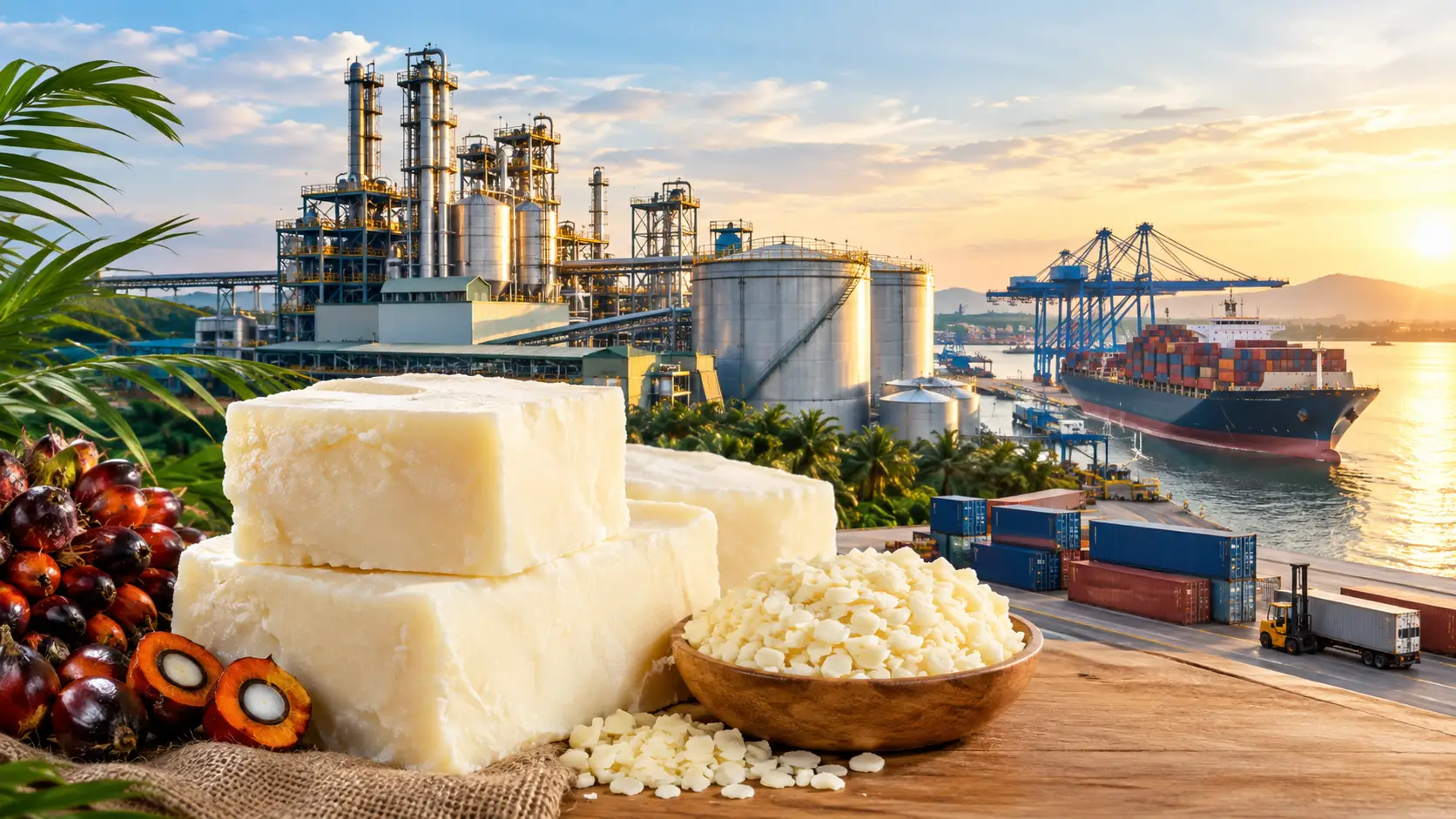
The commercial supply chain begins with oil-palm cultivation and crude palm oil production, followed by refining and fractionation. The resulting fractions are directed toward different downstream markets according to physical characteristics, specifications and demand. For buyers, this means RBD Palm Stearin availability is connected not only to direct stearin demand but also to the broader economics of palm oil refining, edible-oil consumption and fractionation capacity.
Importance of producing regions
Southeast Asia remains central to the global palm oil supply chain, with Malaysia representing an important refining, processing and export hub. Malaysia recorded 20.28 million tonnes of crude palm oil production in 2025, according to the Malaysian Palm Oil Board, an increase of 4.9% from 2024. The country also reported 54 refineries with 26.15 million tonnes/year of operating capacity at the end of 2025, illustrating the scale of the processing infrastructure supporting palm-derived products.
Why supply-chain visibility matters
For procurement teams, the key issue is not simply whether RBD Palm Stearin exists in the market, but whether consistent material can be delivered at the required specification, quantity, destination and timing. Production cycles, refinery allocations, export conditions, freight availability, inventory positions and downstream demand can all influence commercial availability. A B2B sourcing strategy therefore needs visibility across the chain rather than relying exclusively on spot quotations.
Production and Fractionation Dynamics
Refining and fractionation fundamentals
RBD Palm Stearin is produced after palm oil undergoes refining followed by fractionation, a controlled separation process that divides the oil into fractions with different melting characteristics. The higher-melting fraction becomes stearin, while the more liquid fraction becomes palm olein. This makes stearin structurally different from liquid palm olein and particularly useful where manufacturers need hardness, consistency and a defined melting profile.
Capacity determines supply flexibility
The availability of stearin is closely associated with refinery and fractionation infrastructure. Malaysia's 2025 industry data show a substantial processing base, including 26.15 million tonnes/year of refinery capacity. Such infrastructure provides an important foundation for international trade, although actual commercial availability can vary according to operating rates, feedstock conditions, domestic consumption, export commitments and producer allocation policies.
Feedstock and seasonal influences
Palm oil supply is ultimately linked to agricultural conditions. Weather, plantation productivity, labor availability and harvesting patterns can affect crude palm oil output and consequently influence downstream fraction availability. Malaysia's 2025 performance illustrates how changes in agricultural productivity can materially affect feedstock supply: CPO production reached a decade-high level, supported by stronger yields and improved oil extraction rates.
Implications for B2B procurement
For commercial buyers, this production structure creates a strong argument for planned purchasing rather than purely reactive procurement. Manufacturers with predictable monthly consumption can benefit from framework agreements, scheduled shipments and supplier allocation arrangements. Importers should also distinguish between nominal producer capacity and immediately available export volume, because refinery capacity alone does not guarantee a particular grade or shipment slot at a given time.
Global Market and Price Outlook
Market growth and demand fundamentals
RBD Palm Stearin has developed beyond a simple palm-oil fraction into an important industrial raw material serving food and oleochemical markets. IMARC estimates the global RBD Palm Stearin market at approximately USD 14.7 billion in 2025 and projects it to reach USD 23.0 billion by 2034, representing a projected 5.08% CAGR during 2026–2034. The analysis identifies food processing, bakery and oleochemical demand among the major market drivers.
Recent regional pricing signals
Pricing remains highly sensitive to supply-demand balance and regional purchasing behavior. IMARC reported Q4 2025 reference prices of approximately USD 1,122/MT in Malaysia, USD 1,027/MT in Indonesia, USD 1,048/MT in China, USD 1,045/MT in India and USD 1,185/MT in the Netherlands. In Q1 2026, the Netherlands reached approximately USD 1,159/MT in March, with the market influenced by sufficient import supply and cautious downstream purchasing. These figures should be treated as market indicators rather than universal transaction prices.
What moves the price
RBD Palm Stearin pricing can respond to crude palm oil availability, refinery margins, export policies, freight costs, inventory levels and demand from food and industrial users. Substitution pressure from other vegetable fats can also influence purchasing decisions, particularly when manufacturers have formulation flexibility. Consequently, procurement teams should compare offers on a landed-cost basis rather than focusing only on the headline FOB or origin price.
Outlook for commercial buyers
The market outlook favors disciplined procurement because availability and pricing can shift with agricultural output and international trade conditions. Buyers with recurring requirements should monitor producer-country supply, freight conditions and downstream demand while maintaining more than one qualified sourcing channel. A structured procurement program can reduce exposure to sudden spot-market movements while improving supply continuity for production schedules.
Applications Driving Commercial Demand
Food manufacturing and structured fats
Food manufacturing remains one of the most important demand centers for RBD Palm Stearin. Its relatively high melting profile and solid structure make it suitable for shortening, bakery fats, margarines and other formulated fat systems where manufacturers require texture and structural stability. Codex's edible palm stearin framework specifies a minimum slip point of 44°C, demonstrating the importance of melting behavior in defining the material.
Bakery and confectionery formulations
In bakery applications, RBD Palm Stearin can contribute to the structure and consistency of fat systems used in commercial baked goods. Procurement decisions in this segment are typically connected to formulation requirements, processing conditions and finished-product characteristics. Confectionery and specialty-fat manufacturers similarly evaluate melting behavior, texture and compatibility with other fats before approving a supplier or specification.
Oleochemical and soap manufacturing
Beyond food, palm stearin serves as an important feedstock for oleochemical processing and soap production. Its solid-fat characteristics and fatty-acid composition support applications where manufacturers need a stable palm-derived raw material. This diversification is strategically important because it means demand is not dependent on a single end-use sector, helping create a broader industrial market for the product.
Industrial and personal-care demand
Palm-derived stearin fractions can also participate in personal-care and other industrial formulations where hardness, stability or fatty-acid functionality is required. The broader oleochemical industry creates additional routes into soaps, surfactants and related products. For suppliers, this means commercial positioning should clearly distinguish food-grade requirements from industrial-grade applications because documentation, specifications and regulatory expectations can differ substantially.
Buyer Requirements and Quality Evaluation
Specification control
B2B buyers should evaluate RBD Palm Stearin against a defined technical specification rather than purchasing solely according to product name. Common commercial parameters include free fatty acids, moisture and impurities, iodine value, color and melting or slip point. One commercial specification, for example, lists free fatty acids at 0.2% maximum, moisture and impurities at 0.15% maximum, melting point at 44°C minimum and iodine value at 48 maximum. Actual requirements should always follow the producer's confirmed specification and the buyer's application.
Food-grade compliance
For food manufacturers, technical compliance extends beyond basic physical characteristics. Buyers may require certificates of analysis, food-grade declarations, contaminant information, traceability documents and destination-market compliance documentation. Codex provisions emphasize internationally recognized quality and compositional criteria for edible palm stearin, making specification alignment an important part of cross-border purchasing contracts.
Supplier qualification
Supplier evaluation should consider more than quoted price. Procurement teams should review manufacturing origin, consistency of specifications, production capability, export experience, documentation quality, packaging options and responsiveness to technical inquiries. A supplier that can provide stable specifications and predictable shipment execution may deliver better total procurement value than a lower-priced source with inconsistent quality or unreliable logistics.
Commercial documentation
A robust purchasing process normally aligns the purchase specification, certificate of analysis, packing details, origin documentation, shipping documents and agreed Incoterms before shipment. This reduces the risk of disputes at destination and gives quality, procurement and logistics teams a common reference point. For international buyers, clear documentation is particularly important where food, customs or regulatory authorities require product-specific evidence.
International Sourcing and Logistics Strategy
Origin selection
Malaysia and Indonesia remain central to the palm-derived supply chain, but origin selection should be based on the buyer's complete landed-cost and risk profile. Factors include product availability, producer allocation, port infrastructure, shipping frequency, freight rates and destination requirements. Malaysia's large refinery infrastructure demonstrates why the country remains strategically relevant to international palm-derived product procurement.
Packaging and shipment planning
RBD Palm Stearin can be supplied in different commercial formats depending on the producer, application and shipment size. Bulk flexibags, drums, cartons and other formats may be available, with the optimal option depending on consumption volume, storage infrastructure and destination handling requirements. Shipment planning should account for loading temperature, product handling, container utilization and storage conditions so that the material arrives in commercially usable condition.
Freight and landed-cost management
International freight can materially change the economics of RBD Palm Stearin. Buyers should therefore evaluate the complete landed cost, including product price, freight, insurance, port charges, duties, inland transportation and applicable handling costs. For regular importers, comparing alternative origins and shipment frequencies can reveal opportunities to reduce logistics exposure without compromising supply continuity.
Risk management across the chain
Supply-chain resilience becomes particularly important when buyers depend on a single origin, supplier or shipment window. Procurement teams can mitigate this exposure through approved alternative suppliers, forward purchasing, safety stock and clearly defined quality specifications. The objective is not simply to hold more inventory, but to create sufficient flexibility to manage disruptions without interrupting manufacturing operations.
Building a Reliable RBD Palm Stearin Procurement Strategy
Matching specifications to application
The most effective sourcing strategy begins with application-specific requirements. A bakery manufacturer, soap producer and oleochemical processor may all purchase RBD Palm Stearin but require different commercial specifications, packaging and documentation. Buyers should therefore define the intended application, physical form, melting profile, quality parameters and destination regulations before requesting quotations.
Balancing price and supply security
Lowest-price purchasing can create hidden costs when inconsistent supply leads to production delays, emergency freight or reformulation. A stronger commercial approach evaluates price alongside specification reliability, shipment performance, supplier capacity and documentation. Current market benchmarks demonstrate why timing matters: RBD Palm Stearin prices have moved differently across Malaysia, Indonesia, India, China and Europe as regional supply and demand conditions changed.
Using B2B sourcing networks
A specialized B2B marketplace can help procurement teams connect product requirements with suitable international supply channels. For Tradeasia, the commercial opportunity lies in combining product knowledge with supplier relationships, destination-market understanding and logistics coordination. This approach can be particularly valuable for buyers that require recurring volumes and want to compare supply options without managing numerous disconnected supplier conversations.
Conclusion: securing long-term supply
RBD Palm Stearin is a strategically important palm-derived material whose commercial value depends on the interaction between agricultural supply, refining capacity, fractionation, international trade and downstream manufacturing demand. With Malaysia producing 20.28 million tonnes of CPO in 2025 and maintaining substantial refinery capacity, the Southeast Asian supply base remains fundamental to global availability.
For B2B buyers, successful procurement therefore requires more than identifying a competitive price. Specification control, supplier qualification, quality documentation, origin diversification, freight planning and inventory strategy all contribute to a dependable supply chain. Monitoring market benchmarks and production conditions can further improve purchasing decisions as regional supply and demand change.
As demand from food processing, bakery, oleochemicals and other industrial segments develops, buyers increasingly need sourcing partners capable of coordinating product quality with commercial and logistics requirements. Tradeasia International, together with its Chemtradeasia and Tradechem Marketplace platforms, can serve as a practical channel for businesses seeking structured international sourcing of RBD Palm Stearin and other industrial raw materials.
A supply strategy built around transparent specifications, qualified suppliers and dependable international logistics can help manufacturers protect production continuity while managing total procurement cost. For companies purchasing RBD Palm Stearin at commercial scale, that combination of market intelligence and supply-chain execution is increasingly important to long-term competitiveness.
Sources
https://www.bepi.mpob.gov
https://www.fao.org
https://www.imarcgroup.com
Leave a Comment