In the industrial production of processed foods, color is often the first attribute to suffer during thermal processing. High temperatures required for baking, extrusion, and hard-crack candy making can destroy delicate chromophores, leading to fading or browning. For food technologists, selecting a colorant that can survive the oven without shifting hue is critical for brand consistency. Sunset Yellow FCF (E110) remains the industry standard for orange and yellow hues, primarily due to its exceptional thermal stability profile which far outclasses natural alternatives like beta-carotene or paprika oleoresin.
The Chemistry of Heat Resistance
Sunset Yellow FCF is a synthetic azo dye.1 Its molecular structure consists of stable aromatic rings linked by an azo bond (2$-\text{N}=\text{N}-$).3 This structure is inherently robust. Technical data indicates that in its pure dry powder form, Sunset Yellow FCF remains thermally stable up to approximately 300°C to 330°C before significant decomposition occurs.4
While moisture lowers this threshold slightly, it remains remarkably stable under standard food processing conditions. For example, during the "hard crack" stage of candy production (approx. 150°C - 160°C), many natural colors begin to degrade or oxidize, turning brown. Sunset Yellow FCF, however, maintains its vibrant orange-red integrity. In the presence of sugars (glucose/sucrose), decomposition is minimal (less than 10%) even at these critical temperatures, ensuring the final lollipop or hard candy looks as vibrant on the shelf as it did in the mixing vat.
Performance in Baked Goods and Extruded Snacks
The baking industry faces a unique challenge: the Maillard reaction. As crusts brown and internal temperatures rise (internal crumb temps reach ~98°C, but surface temps much higher), pH levels can fluctuate. Natural colors often shift hue under these conditions—turmeric can turn red in alkaline doughs, and anthocyanins can turn blue or grey.
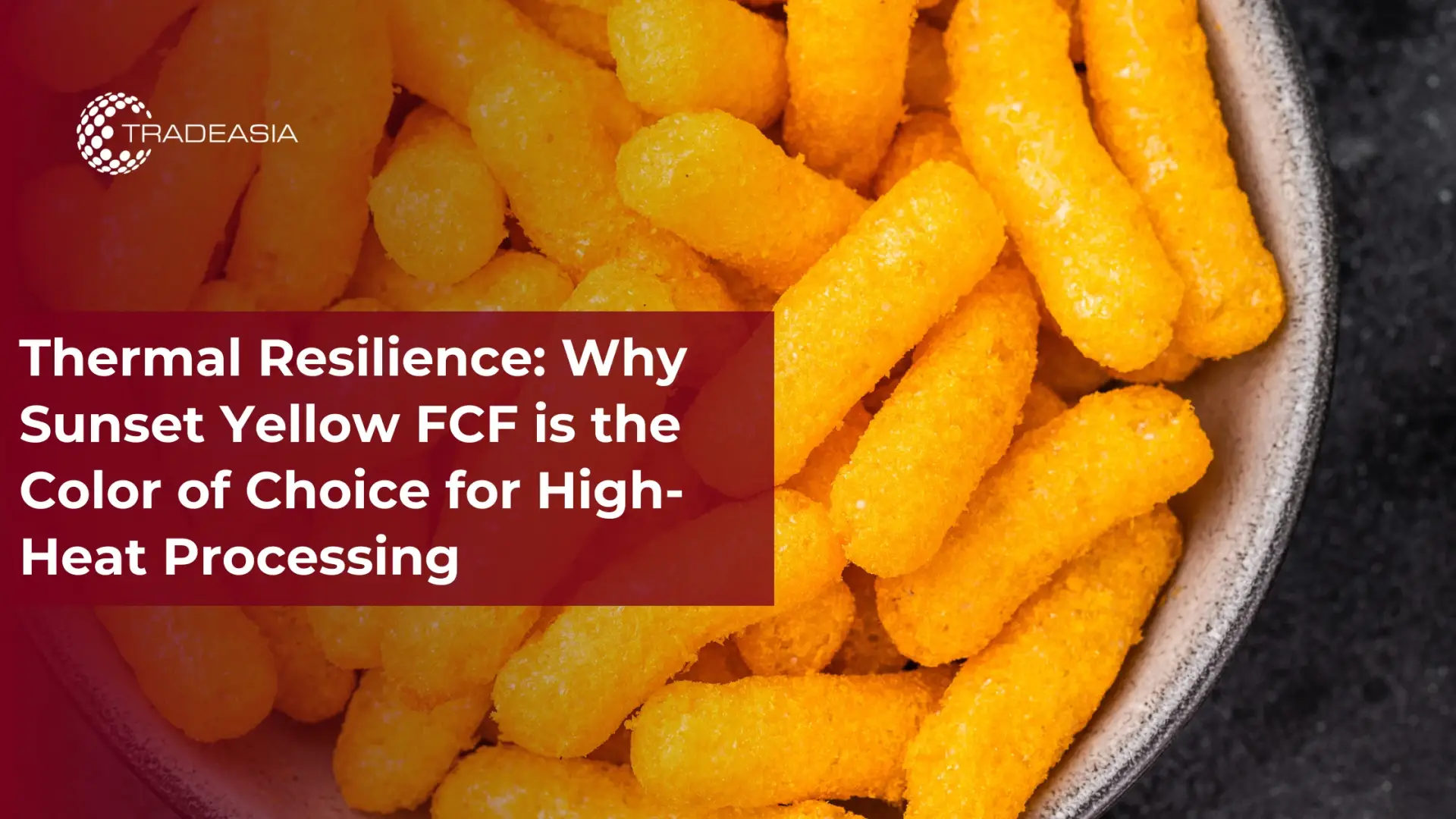
Sunset Yellow FCF is pH stable and heat resistant.5 In the production of cookies, cakes, and wafers, it provides a consistent "egg-yolk" yellow or "sunset" orange that does not "bake out." This is particularly vital in extruded snacks (like cheese puffs). The extrusion process involves high pressure, high shear, and flash heat. Encapsulated natural colors frequently shear open and degrade during this violent process. Sunset Yellow FCF, being a water-soluble salt, integrates molecularly into the dough matrix, surviving the extruder die to produce a uniformly colored snack without the speckling or fading associated with less stable additives.
Economic Advantages Over Natural Alternatives
Beyond technical performance, the thermal stability of Sunset Yellow FCF translates directly to cost efficiency. Because it does not degrade significantly during processing, manufacturers do not need to "overdose" the product to compensate for color loss—a common practice when using beta-carotene.
Natural orange colors often require expensive encapsulation technologies to survive heat, or they require cold-addition steps which complicate the manufacturing line. Sunset Yellow FCF is a "add-and-forget" solution. It can be added at the beginning of the mixing process, withstanding pasteurization, boiling, and baking. For large-scale industrial bakeries and confectioners, this reliability reduces batch rejections and simplifies inventory management, as one stable dye can be used across multiple product lines regardless of the thermal processing method involved.
Sources
Leave a Comment