Vanillin Market Role and Commercial Demand
What is vanillin?
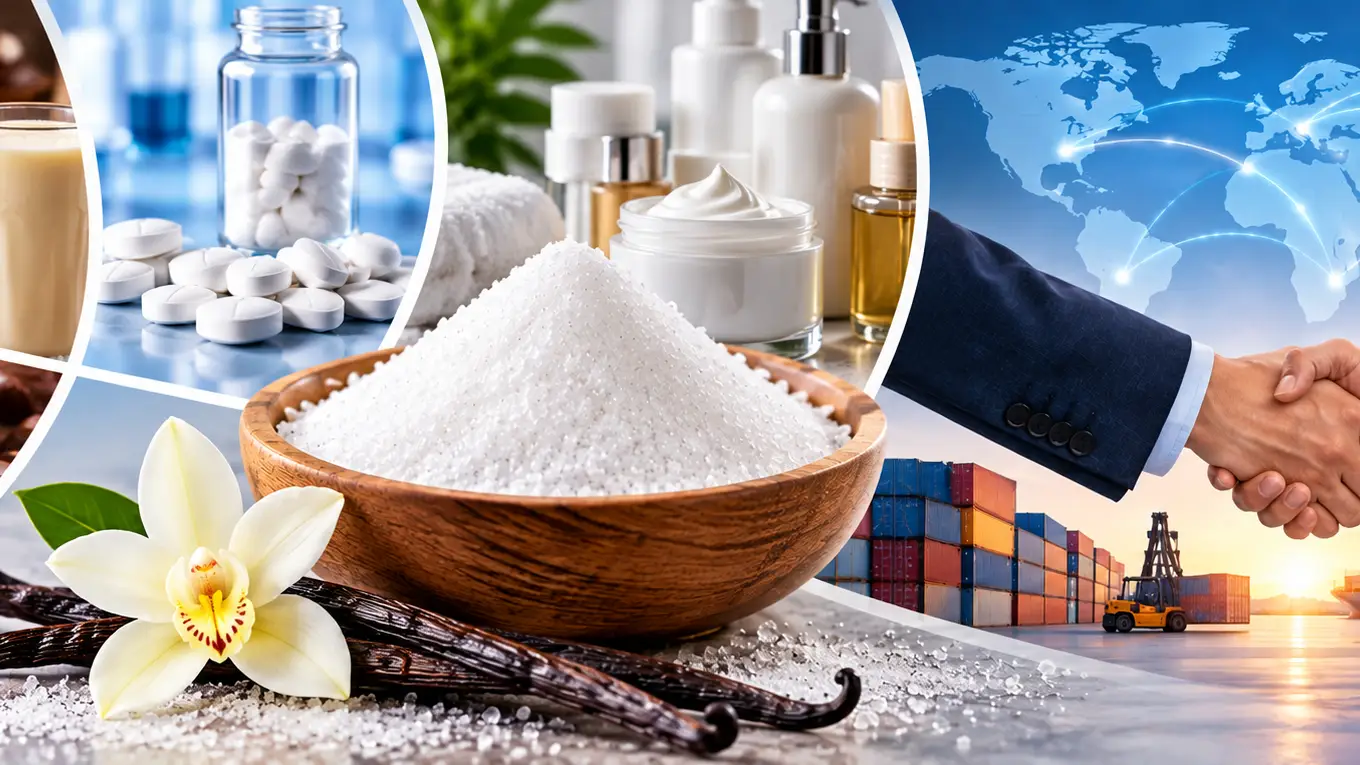
Vanillin is an aromatic organic compound best known for providing the characteristic vanilla aroma and flavor associated with vanilla. Chemically identified as 4-hydroxy-3-methoxybenzaldehyde, vanillin is commercially important because its functionality extends beyond a single consumer product category. It is used across food, beverage, pharmaceutical, fragrance, cosmetic, and other industrial applications, making it a versatile ingredient for B2B procurement. A scientific review published in the European Journal of Medicinal Chemistry Reports describes vanillin as a widely used aromatic flavoring compound with applications in food, beverages, pharmaceuticals, perfumes, and cosmetics.
Why vanillin has broad commercial relevance
The commercial value of vanillin comes from the combination of sensory performance, established industrial use, and flexibility across formulations. Food manufacturers can use it as a flavoring component, while fragrance and personal-care formulators can incorporate its characteristic aromatic profile into finished products. Pharmaceutical and chemical manufacturers may also use vanillin or vanillin-derived chemistry in specialized applications. This broad end-use base means that vanillin applications should be evaluated according to the buyer's formulation, regulatory requirements, grade expectations, and intended market rather than simply by product name.
Natural and synthetic supply considerations
Vanillin can originate from natural vanilla sources or from synthetic and biotechnological production routes. Recent scientific literature highlights continuing interest in extraction, purification, biosynthesis, and biotransformation because natural vanilla-derived vanillin has supply and cost constraints compared with larger-scale alternatives. A 2025 review in Food Chemistry specifically examined natural, synthetic, and biotransformation routes while emphasizing analytical characterization and authentication.
Why this matters to B2B buyers
For procurement teams, vanillin is therefore not simply a commodity flavoring material. The sourcing decision can affect formulation consistency, product positioning, regulatory documentation, cost management, and supply continuity. Buyers evaluating an industrial vanillin supplier need to establish which type of material is appropriate for their application and then compare suppliers on specification, documentation, consistency, availability, logistics, and commercial terms. This is where a specialized B2B chemical marketplace can function as a practical starting point for supplier discovery and qualification.
Vanillin Applications Across Major Industries
Food and beverage applications
Food and beverage remains one of the most commercially important areas for vanillin applications. Vanillin can contribute a recognizable vanilla profile to products such as bakery formulations, confectionery, desserts, beverages, dairy-related products, and other flavored food systems. The U.S. Food and Drug Administration's food-substance database identifies vanillin under CAS 121-33-5 and lists its technical effect as a flavoring agent or adjuvant, with relevant U.S. regulatory references.
Pharmaceutical applications
The pharmaceutical sector represents another important area of vanillin demand. Beyond its role in pharmaceutical preparations where flavor and sensory characteristics can be relevant, scientific literature describes broader research into vanillin's chemical and biological properties. A 2022 review notes applications in pharmaceuticals and discusses research into antioxidant, antimicrobial, anti-inflammatory, and other biological activities, although such research findings should not automatically be interpreted as approved therapeutic claims for commercial vanillin products.
Cosmetics, fragrances, and personal care
Vanillin also has commercial relevance in cosmetics, fragrances, and personal-care formulations because of its distinctive aromatic character. For fragrance and formulation teams, the material can be considered according to the desired scent profile, formulation compatibility, purity, stability, and applicable regulatory requirements. The breadth of these applications means that a vanillin supplier serving multiple industrial sectors may need to support buyers with clear product specifications and application-relevant documentation rather than relying on a generic product description.
Chemical and specialty applications
Vanillin's aldehyde, hydroxyl, and methoxy functional groups also make it relevant to chemical research and specialty applications. Recent reviews have examined vanillin beyond traditional flavor use, including its potential role in biomedical materials, drug-delivery research, and other advanced applications. These emerging uses do not replace the established food and fragrance markets, but they demonstrate why industrial buyers increasingly evaluate vanillin as a multifunctional chemical building block rather than solely as a flavor ingredient.
Emerging Applications and Market Trends
Interest in bio-based vanillin
One of the clearest developments in the vanillin supply landscape is increased attention to natural and bio-based production. Scientific reviews have examined extraction from natural sources, microbial or enzymatic transformation, and alternative production pathways. The 2023 review in Industrial Crops and Products highlights the need for improved extraction and purification approaches and identifies environmental impact, production cost, source, and required purity as important considerations in developing vanillin supply routes.
Authentication and quality transparency
As buyers distinguish among natural, synthetic, and biotechnologically produced materials, analytical verification becomes increasingly important. A 2025 review in Food Chemistry discusses authentication, chemical and sensory analysis, and the detection of sophisticated adulteration in vanillin-related products. For procurement teams, this reinforces the importance of documentation and traceability when sourcing materials for regulated or quality-sensitive applications.
Expansion beyond conventional flavoring
Another important trend is the investigation of vanillin-derived materials in applications outside conventional flavoring. Recent research has examined vanillin-related chemistry in biomedical materials and other advanced fields. A 2026 International Journal of Pharmaceutics paper, for example, investigated vanillin as a functional component in biomedical formulations and material design. These studies remain application-development research rather than proof of broad commercial adoption, but they indicate a growing scientific interest in the molecule's functional chemistry.
What the trends mean for B2B demand
For manufacturers, distributors, and procurement teams, these developments create a more segmented vanillin market. Some buyers primarily need dependable flavoring performance and cost efficiency, while others may prioritize origin, production route, purity, documentation, or application-specific specifications. Consequently, vanillin market demand should be viewed through the requirements of different end-use segments rather than as a single homogeneous market. Suppliers capable of clearly communicating product characteristics and application suitability can be better positioned to serve these differentiated procurement needs.
Vanillin Buyer Intent and Procurement Priorities
Who buys vanillin?
Typical vanillin buyers include food and beverage manufacturers, flavor houses, fragrance companies, cosmetic formulators, pharmaceutical manufacturers, chemical processors, distributors, and trading companies. Procurement may be direct from producers or conducted through distributors and B2B marketplaces depending on volume, geography, technical requirements, and supply-chain structure. Each buyer group can have different priorities, so commercial sourcing should begin with a clear definition of the intended application and purchasing specification.
What procurement teams evaluate
Before purchasing, procurement teams commonly need to assess product identity, purity, applicable specifications, documentation, packaging, minimum order quantities, lead times, origin, and commercial terms. For food-related applications, regulatory suitability and supporting documentation can be particularly important. The FDA's current food-substance information confirms vanillin's recognized use as a flavoring agent or adjuvant in the U.S. regulatory framework, illustrating why buyers should match the intended application with the applicable regulatory requirements.
Why buyers compare suppliers
Supplier comparison is important because two commercially available vanillin products may not provide identical sourcing propositions. Buyers may compare price alongside specification, production route, consistency, availability, documentation, logistics capability, and responsiveness. For companies operating continuous production, dependable supply can be just as important as the nominal purchase price because interruptions or inconsistent material can create additional formulation, production, or inventory-management costs.
How a product page supports sourcing
A well-structured vanillin sourcing page gives buyers a starting point for understanding the material and initiating a commercial discussion. Tradeasia's Vanillin product page can serve as the relevant product-level entry point for buyers researching vanillin for industrial applications. The commercial objective is not simply to present the chemical name, but to help qualified buyers move from product discovery toward specification review, supplier comparison, inquiry, and procurement.
Vanillin Sourcing and Supplier Evaluation
Matching product requirements to applications
Effective vanillin procurement begins by matching the material with the intended end use. A food manufacturer, pharmaceutical company, fragrance producer, and chemical processor may have different expectations regarding specifications, documentation, regulatory status, and formulation performance. Procurement teams should therefore define the application before comparing commercial offers, because the lowest quoted price is not necessarily the lowest total sourcing cost if the material does not meet the required specification.
Assessing supplier reliability
Supplier reliability should be considered across availability, production capability, communication, documentation, packaging, and logistics. Buyers with recurring requirements may also evaluate whether a supplier can support consistent volumes and predictable lead times. For international trade, factors such as shipping routes, destination requirements, customs documentation, and regional availability can influence the practical value of an offer. This makes supplier qualification a strategic step rather than a purely transactional price comparison.
Quality and documentation
Quality management is especially relevant where vanillin enters regulated or specification-sensitive formulations. Recent research on vanillin production and authentication emphasizes analytical characterization and the need to distinguish among different sources and production methods. Buyers should therefore request appropriate technical and commercial documentation and verify that the supplied material corresponds with their application requirements before committing to larger volumes.
Using a B2B marketplace for supplier discovery
A B2B chemical marketplace can simplify the initial stages of commercial vanillin sourcing by bringing product information and supplier-oriented purchasing pathways closer together. For procurement teams, the value lies in reducing search friction and creating a structured starting point for inquiry and supplier evaluation. Tradeasia / Chemtradeasia / Tradechem Marketplace can position vanillin within this workflow by connecting product discovery with commercial sourcing conversations without overstating the product's suitability for any particular application.
Commercial Opportunities for Vanillin Buyers and Suppliers
Demand from established end-use markets
The established food, beverage, pharmaceutical, cosmetics, and fragrance sectors provide the strongest commercial foundation for vanillin. Scientific literature consistently identifies these industries among the principal areas of use, while regulatory databases demonstrate vanillin's recognized role as a food flavoring substance. For suppliers, this diversified end-use base can provide opportunities across multiple customer segments rather than dependence on one downstream industry.
Opportunities for manufacturers and distributors
Manufacturers and distributors can differentiate their vanillin offerings by aligning supply capabilities with buyer requirements. Application knowledge, reliable documentation, consistent specifications, appropriate packaging, and responsive commercial support can all contribute to supplier attractiveness. As buyers increasingly investigate natural, synthetic, and alternative production routes, suppliers that clearly communicate sourcing characteristics can make it easier for procurement teams to assess the right option for their formulation or production process.
Opportunities from emerging applications
Emerging research can create longer-term opportunities beyond established flavor and fragrance demand. Reviews have identified areas including biomedical research, advanced materials, and other specialty applications, while recent research has investigated vanillin-derived chemistry for sustainable agriculture and other technologies. These applications should be treated as development opportunities rather than guaranteed commercial demand, but they demonstrate the broader technical potential of the molecule.
Converting market interest into sourcing activity
For B2B marketplaces, the commercial opportunity is to connect application interest with practical procurement. Buyers searching for vanillin supplier, vanillin applications, or buy vanillin often need more than general technical information; they need a pathway toward specifications, supplier communication, quantities, and delivery requirements. A focused product listing can therefore act as a conversion point between market research and an actual sourcing inquiry, particularly when it is supported by clear product information and relevant application context.
Conclusion: Building a Reliable Vanillin Sourcing Strategy
Vanillin's role in industrial markets
Vanillin remains commercially important because it combines a well-established role as a flavoring material with applications in fragrances, cosmetics, pharmaceuticals, and specialty chemical research. Its broad application base creates demand from diverse buyer groups, while developments in natural extraction, biotechnology, authentication, and advanced applications continue to expand the technical conversation around the material.
What buyers should prioritize
For procurement teams, the most effective sourcing strategy starts with application requirements and then evaluates specification, quality, documentation, supply reliability, logistics, and commercial competitiveness. Buyers should also distinguish between established industrial applications and emerging research areas so that purchasing decisions remain aligned with actual regulatory and technical requirements. This approach helps companies avoid treating vanillin as a one-size-fits-all commodity.
The role of supplier and marketplace selection
Reliable supplier discovery can reduce sourcing friction when procurement teams are entering a new market or comparing alternative supply channels. A dedicated vanillin product page can provide a practical starting point for reviewing the material and initiating a commercial inquiry, while marketplace infrastructure can support broader supplier discovery and communication. For buyers evaluating vanillin for industrial applications, Tradeasia's Vanillin sourcing information provides a direct product-level route into that sourcing process.
Turning application demand into B2B opportunities
Ultimately, vanillin presents a commercially relevant intersection of established demand and evolving industrial applications. Food and beverage remain central use areas, while pharmaceutical, cosmetics, fragrance, specialty chemical, and emerging technology applications broaden the addressable buyer base. For manufacturers, traders, distributors, and procurement teams, the strongest opportunity is to approach vanillin sourcing through application fit, verified quality, dependable supply, and transparent supplier communication—turning product interest into informed and sustainable B2B purchasing decisions.
Leave a Comment